Legacy — 12 min read
The girl who became me
Don't let the details quietly disappear. It's easy to assume there will always be another holiday, another cup of coffee, another long drive to tell stories. Then one day, often without warning, we realize we're the keeper of those memories. And one day we will not be able to tell anyone what happened or how it felt. Cancer taught me something about time: the conversations we postpone do not always wait for us.
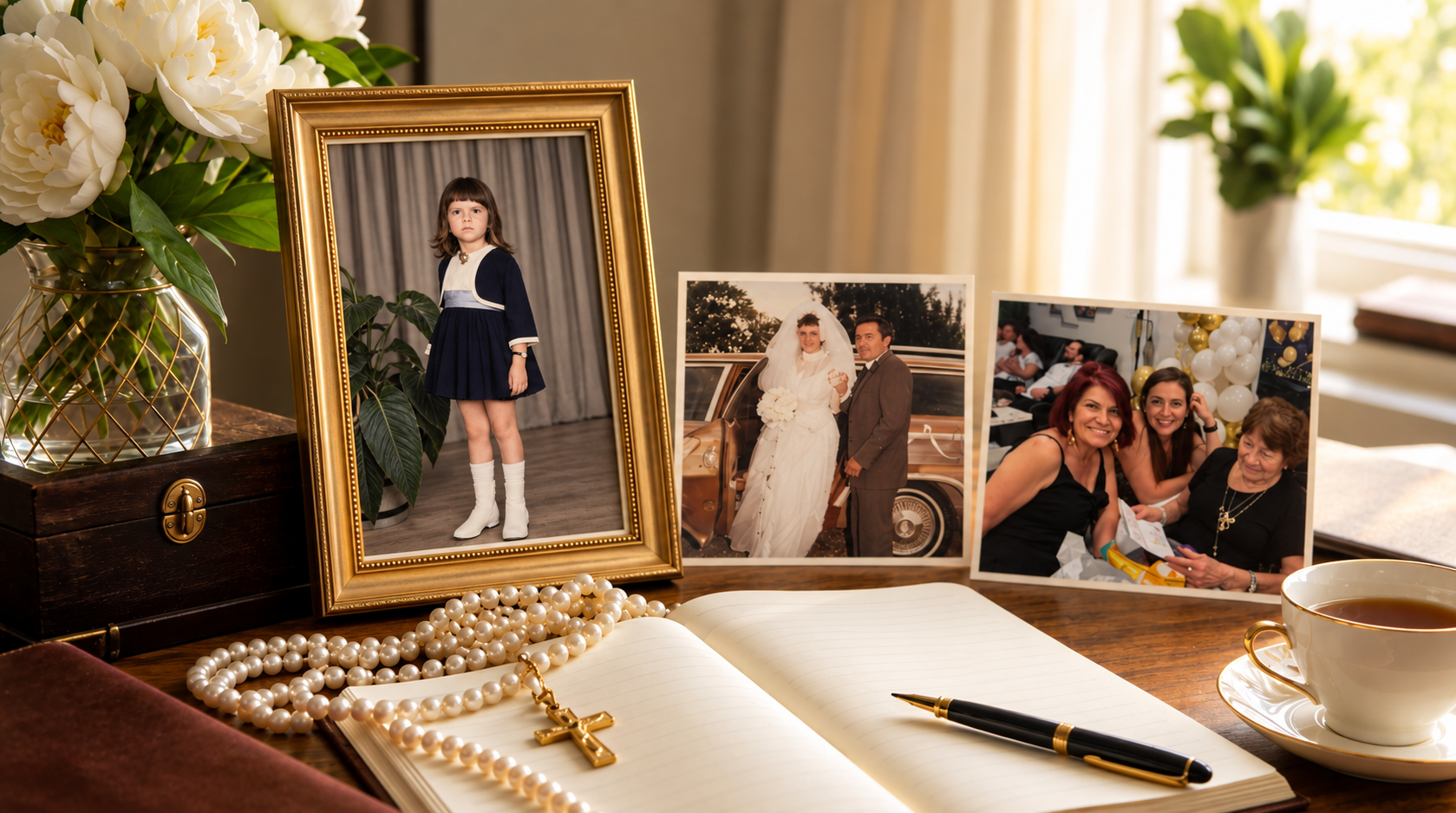
Chapter One
Before the world got bigger
Before I knew there was a world beyond my homeland, this was my world: the unmistakable smell of Christmas Eve, five pounds of black cake and five pounds of white cake baking in the oven on Christmas Eve followed by turkey and ham sizzling in time for sandwiches after midnight mass. The house came alive with general cleaning, fresh linoleum covering the floors, and new bedcovers my mother sewed until she fell asleep at the sewing machine. On ordinary days the neighbors lawnmower hummed in the early morning, the sun warmed my skin, and the familiar voices of neighbors surrounded me, people who knew me before I knew how to introduce myself.
I was a girl who believed the world was both small and enormous. Small because everyone seemed connected, because family, neighbors, and friends were woven into one another's lives. Enormous because my imagination had no boundaries.
I didn't know then that one day I would win a full scholarship in a faraway land.
I didn't know I would cross oceans, build careers, raise children, experience heartbreak, and vacation in countries and cities I could barely pronounce, and become a woman who would have to learn how to be strong.
Back then, I was simply a girl growing up in my homeland, a child of the 1970s, when "Disco Duck" played and bell-bottoms swayed, and I carried a borrowed dream, not yet learned to call my own.
I noticed things. I listened. I wrote poems, dreamed, and loved easily.
When I look back now, I realize that the woman I became was already there inside that little girl. I just hadn't met her yet.
Chapter Two
The dream I carried quietly
There were dreams I spoke about and dreams I kept tucked away where no one could touch them.
I knew I wanted more for my life, although I couldn't always explain what "more" meant. I wanted to learn. I wanted to accomplish something. I wanted a life that felt bigger than the circumstances around me.
There was ambition in me, but there was also innocence.
I didn't yet understand how expensive dreams could be.
I thought wanting something badly enough might be enough to make it happen. I hadn't learned yet that life sometimes changes the question before you have finished answering it.
Still, I carried that dream.
Quietly.
And perhaps that is what mattered most.
Because before life taught me disappointment, it taught me hope.
Chapter Three
The day I left home
Leaving the homeland was more than getting on an airplane.
It was leaving behind a version of myself.
I was barely eighteen — 1981, the age when the future is still a theory. I remember the feeling of knowing that everything familiar was about to become memory. I carried my belongings, but what I really carried was much heavier: my family, my childhood, the sound of home, the smell of the homeland, and every dream I had for the woman I hoped to become.
A full scholarship in a faraway land seemed full of possibility.
I imagined opportunity. I imagined a future. I imagined that if I studied enough, I could achieve the profession I had dreamed about.
But underneath the excitement was fear.
What happens when you leave the place that taught you who you are?
I didn't know.
I only knew that this was an opportunity of a lifetime.
And sometimes courage doesn't feel like courage when you're living it. Sometimes courage feels like being scared and getting on the plane anyway.
Chapter Four
Becoming a mother for the first time
The first time I held my child, something inside me changed forever.
I remember the physical tenderness of that moment, the tiny body, the fragile fingers, the overwhelming realization that someone could need me so completely.
Love became something I could touch.
It was beautiful.
And terrifying.
Because motherhood taught me immediately that love makes you vulnerable. Suddenly, someone else's happiness mattered as much as my own. Someone else's pain could become my pain. Someone else's future could keep me awake at night.
I didn't know if I would be a perfect mother.
I knew I wouldn't.
But I knew I would love fiercely.
I would learn.
I would make mistakes and apologize.
I would pray.
And when I didn't know what else to do, I would keep showing up.
That became one of the first great lessons of my life: sometimes motherhood isn't knowing exactly what to do. Sometimes it is simply refusing to stop loving.
Chapter Five
When life broke open
There are moments in life when everything you thought was permanent suddenly isn't.
The marriage ending was one of those moments for me.
There was shock first.
Then grief.
Then the silence.
The kind of silence that follows the collapse of something you thought would be part of your life forever.
I had questions I couldn't answer and emotions I didn't know where to put. There were days when I felt angry, days when I felt afraid, and days when I simply felt tired.
But underneath the heartbreak was a woman who still had children to care for.
Life did not pause because my heart was broken.
Breakfast still had to be made.
Bills still had to be paid.
Children still needed hugs.
So I got up.
Not because I was fearless.
Because I was needed.
There is a particular kind of strength that nobody applauds.
It is the strength of getting out of bed when your heart wants to stay there. I learned that strength. And I learned that dignity doesn't mean you don't hurt. It means you don't let the hurt decide who you become.
Chapter Six
Raising three children alone
There were mornings when I wondered how I was going to make everything work.
School mornings.
Work.
Bills.
Groceries.
Homework.
Laundry.
Dinner.
Bedtime.
Then doing it all again.
There wasn't always enough money. There wasn't always enough energy. And there certainly weren't always enough hours in the day.
But there was love.
I learned to stretch a dollar and stretch myself.
I learned that children don't need a perfect mother. They need a mother who is present, who protects them, who believes in them, and who keeps coming back to the kitchen table.
At night, after the noise of the day finally became quiet, I would sometimes pray.
Sometimes the prayer was beautiful.
Sometimes it was only: "God, please help me."
And somehow, morning always came.
We made it through one day.
Then another.
Then another.
Looking back, I realize that I wasn't just raising three children.
We were raising one another.
They were becoming themselves.
And I was becoming me.
Chapter Seven
The season I had to survive
There were seasons when survival became the assignment.
Not thriving.
Not accomplishing.
Not planning the next great thing.
Just surviving.
There were moments when my body was tired, my heart was lonely, and my future felt uncertain. There were days when fear sat beside me so quietly that I almost forgot it was there.
Illness has a way of changing your relationship with time.
You begin to understand that tomorrow is not something you are owed. It is something you are given.
And when I was afraid, I learned to live one day at a time.
One appointment.
One conversation.
One prayer.
One morning.
One breath.
I discovered that being strong does not mean pretending you're not afraid. It means being afraid and continuing anyway.
There were days I felt broken.
But broken is not the same as finished.
That distinction saved me.
Chapter Eight
What faith sounded like in my life
Faith was not certainty; it meant taking the next step while still afraid and deciding to trust when no explanation arrives.
My faith was not always loud.
Sometimes it sounded like singing.
Sometimes it sounded like Scripture.
“For it is by grace you have been saved, through faith — and this is not from yourselves, it is the gift of God — not by works, so that no one can boast.”
Ephesians 2:8–9 (NIV)
Sometimes it sounded like the quiet of a room after everyone else had gone to sleep. And sometimes it sounded like tears.
I prayed when I understood.
I prayed when I didn't.
I prayed when I was grateful.
I prayed when I was angry.
I prayed when I was afraid that God had forgotten me.
And then there were moments when I felt Him close enough to remind me that He hadn't.
My faith became less about having answers and more about learning to trust without them. I began to understand grace differently.
Grace wasn't a life without pain.
Grace was finding strength I didn't know I had.
Grace was getting another morning.
Grace was a child's laugh.
Grace was forgiveness.
Grace was surviving something I once thought would destroy me. And perhaps most importantly, grace was learning that I didn't have to carry everything alone.
Chapter Nine
The joy we made anyway
Some of my favorite memories are not the moments when everything was perfect. They are the moments when life was imperfect and we laughed anyway.
We traveled.
We celebrated.
We gathered around tables.
We opened Christmas presents.
We shared birthdays.
We visited the homeland.
We explored London.
We were taken aback by Paris.
We breathed in the sweet air of the Caribbean.
We made São Paulo a one-of-a-kind adventure.
We lived Rio de Janeiro.
There were photographs, suitcases, airports, music, food, stories and laughter. There were ordinary evenings that became extraordinary simply because we were together.
Joy became a kind of rebellion.
Life had taken things from us. But it could not take our ability to celebrate what remained.
I learned that happiness doesn't have to wait until everything is fixed. Sometimes you make joy right in the middle of the mess.
You dance.
You travel.
You eat the cake.
You take the picture.
You laugh until your stomach hurts.
You love your people while you have them.
That is not denial.
That is gratitude.
Chapter Ten
What I wanted my children to become
I never needed my children to become perfect.
I wanted them to become good.
Good people.
People who could look someone in the eye.
People who kept their word.
People who understood that success without character is empty. I wanted them to know how to work hard without losing their tenderness. To stand up for themselves without stepping on someone else. To forgive without becoming foolish. To love without losing themselves.
I repeated lessons so many times that I sometimes wondered if they were listening.
Then I watched them grow.
And I realized they were.
Not always in the ways I expected.
Not always on the timeline I imagined.
But somewhere along the way, the things I had tried to teach them began appearing in the people they became.
That is one of the greatest gifts of motherhood.
You pour yourself into people and eventually realize they were never meant to belong to you. They were meant to become themselves.
And when I look at my children now, I feel something deeper than pride.
I feel gratitude.
Chapter Eleven
How I want to be remembered
I don't want to be remembered for the things I owned.
Or the titles I held.
Or the places I traveled.
Or even the things I accomplished.
I want to be remembered for how I loved.
I want my children and grandchildren to remember that I showed up. That I prayed. That I kept going. That I found laughter after tears. That I made a home wherever I was. That I believed broken things could become beautiful again.
I want them to know that I was not fearless.
I was afraid many times.
But I learned that courage is not the absence of fear.
It is choosing love anyway.
Choosing hope anyway.
Choosing faith anyway.
If they remember anything about me, I hope they remember this:
I loved deeply.
I endured bravely.
I prayed faithfully.
And whenever life handed me broken pieces, I tried to build something beautiful with them.
That is the life I was given.
And this is the life I chose to make from it.
Stories that inspire. Brands that matter. Legacies that last.