A waiting room has its own kind of time.
The clock moves, but no one in the room moves with it. A television plays softly in the corner. Someone turns the pages of a magazine without really reading. A name is called, and every head lifts for a moment, then settles again.
When you are waiting for a scan, or waiting for the results, even normal sounds seem louder. The opening of a door. The footsteps in the hallway. The buzz of a phone against your hand.
For twelve months, scans became the markers on my calendar. Each one seemed to split my life into two parts: the days before I knew, and whatever might come after.
I wanted answers. I wanted to be sure. More than anything, I wanted time to move faster.
Instead, God met me in the waiting.
The space between what is known and what is feared
Before cancer, I thought waiting was just an annoyance.
It was the time between making a plan and seeing it happen. It was a delayed flight, a slow checkout line, or an email no one had answered. Waiting was something to manage, to shorten, or to fill.
Then waiting became something else.
It became the space between a test and a result. Between what the doctor could see and what had not yet been explained. Between the life I knew and the future I was suddenly afraid to picture.
Fear is loud in that space.
It tells stories before the facts arrive. It takes one unanswered question and writes a whole ending. It makes you think that if you worry hard enough, maybe you can get ready for whatever comes next.
I tried to pray my way out of that not-knowing.
At first, my prayers were urgent and specific.
Please let everything be clear. Please let the news be good. Please do not let this change my life again.
Those prayers were honest. I believe God welcomes honest prayers, even when they come trembling and unfinished.
But as the months passed, something inside my prayers began to change.
I still asked for healing. I still asked for good results. But I also began to pray:
Lord, stay close while I wait.
That prayer did not make me guess the ending. It only asked me to trust that I would not face it alone.
"The Lord is close to the brokenhearted and saves those who are crushed in spirit."
Psalm 34:18 (NIV)
Prayer did not remove the waiting
I wish I could say that prayer made me completely calm.
It did not.
There were still nights when my mind moved faster than my faith. There were still moments when I studied every look on a technician's face, searching for an answer they could not give me. There were still mornings when courage meant nothing more dramatic than getting dressed, driving to the appointment, and walking through the door.
Prayer did not always change the room.
It changed how I entered it.
I began to understand that faith is not the absence of fear. Faith is choosing where to put the fear when it shows up.
Sometimes my prayers were only a few words whispered under my breath. Sometimes I had no words at all. I just sat still and asked the Holy Spirit to carry what I could not say.
In those moments, I stopped using prayer as a way to control the outcome. Prayer became companionship.
God was not waiting for me on the other side of the result. He was already beside me in the not-knowing.
Patience is not passive
I once thought patience meant staying cheerful while nothing happened.
But patience is not pretending the wait is easy. It is not denying fear, forcing optimism, or acting like not-knowing does not hurt.
Patience is the quiet work of staying present when your heart wants to run ahead.
It is receiving today without demanding that tomorrow explain itself.
That was the deeper lesson of those twelve months. I could not hurry the scans, the doctors, or the answers. I could not make a deal with time. But I could decide not to give up every ordinary day to a future that had not happened yet.
I began to notice how much life was still happening between appointments.
There were conversations worth lingering over. Laughter that arrived without permission. Meals to enjoy while they were still warm. People to love while they were near. Morning light through the window, whether I had remembered to notice it or not.
None of those moments looked important enough to become milestones.
Together, they were my life.
The strange gift of an unhurried life
An unhurried life is not an empty calendar or a perfectly tidy room.
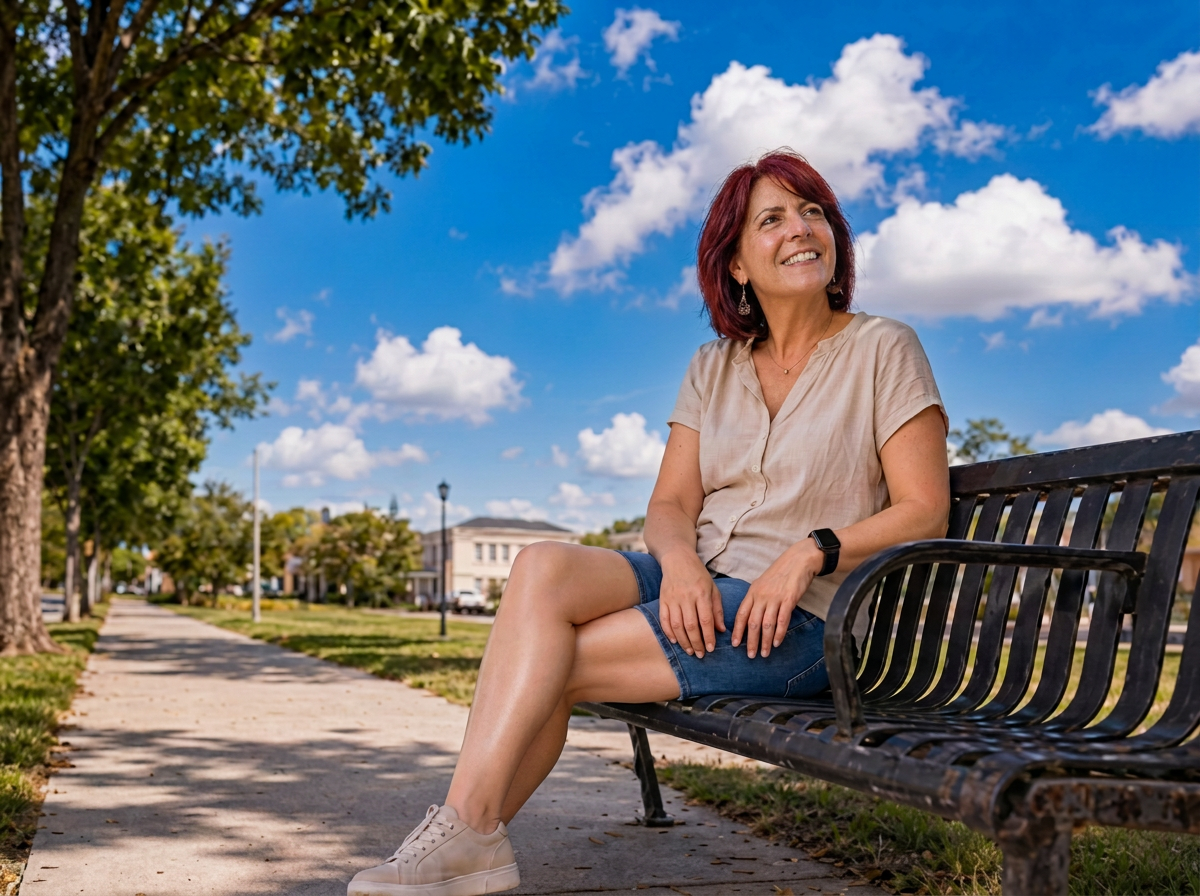
For me, it can be as simple as sitting on a bench and looking up at a blue sky full of clouds. There is nowhere impressive to be, nothing to achieve, and no lesson that has to be pulled from the moment.
I am just there.
The clouds move without my help. The breeze changes direction. People pass by carrying stories I may never know. For a few minutes, I am not rushing toward the next answer.
I am receiving the life right in front of me.
That may be one of the strangest gifts cancer gave me: knowing that slowing down is not the same as falling behind.
We spend so much of life hurrying toward the next chapter that we forget to read the page we are on. We tell ourselves we will rest after the work is done, call someone when the week gets quieter, or pay attention when something important happens.
But the important thing is often happening now.
It is in the cup of coffee growing cold beside us. It is in a grandchild's unexpected question. It is in the voice of someone we love saying our name. It is in the ordinary afternoon we would give anything to revisit once it is gone.
An unhurried life does not refuse responsibility. It refuses to treat every moment as a speed bump on the way to another one.
Grace rarely announces itself
I used to picture grace as the thing that arrived after the crisis — the good news, the answered prayer, the moment when everything finally made sense.
But some kinds of grace do not wait for a tidy ending.
Grace was the strength to walk into another waiting room.
Grace was the person who checked on me without asking me to sound brave.
Grace was a quiet prayer when I could not manage a long one.
Grace was laughter on a day when I thought fear would get the last word.
Grace was the understanding that not-knowing could visit my life without becoming the owner of it.
The scans mattered. The results mattered. But they were not the only things that mattered.
My life was not on pause while I waited.
It was still being lived.
What the waiting room taught me
The waiting room taught me that peace and certainty are not the same thing.
Certainty depends on knowing what will happen. Peace comes from knowing Who stays with us, whatever happens.
It taught me that patience is not measured by how well we hide our fear, but by how faithfully we return to the present.
It taught me that prayer does not need big words. Sometimes the most faithful prayer is simply:
I am afraid, Lord. Please sit with me here.
And it taught me that an unhurried life is not a smaller life.
It is a life roomy enough to notice grace.
I would never call cancer a gift. Some chapters are too painful to dress up, and some losses should never be covered in prettier words.
But I can honor what the chapter taught me.
I can sit under a wide blue sky without asking the clouds to move faster. I can listen longer. Love more on purpose. Pray more honestly. I can stop treating the present as if it were only a hallway leading somewhere else.
We all spend part of our lives in waiting rooms.
We wait for healing, for direction, for a broken relationship to mend, for an opportunity, or for an answer we cannot force. We wait for a door to open, or for the courage to accept that one has closed.
The waiting may not be optional.
But how we live inside it can change us.
Somewhere between the prayer and the answer, between the fear and the next faithful step, grace pulls up a chair.
And if we get still enough, we may find that we were never waiting alone.
The waiting may not be optional. But how we live inside it can change us.